Program
BSides Aarhus 2026 konferenceprogram — to parallelle spor med sikkerhedsforedrag. 20. juni 2026 i Aarhus, Danmark.
BSides Aarhus 2026 programmet har to parallelle spor, der kører hele dagen.
Malware & Monsters: Contain It Before It Evolves
Klaus AgnolettiCompliance now requires incident response exercises. NIS2, DORA, ISO 27001: they all say the exercises have to happen, and the auditors want them documented. The problem is not the requirement. The… Vis mere Vis mindre
Compliance now requires incident response exercises. NIS2, DORA, ISO 27001: they all say the exercises have to happen, and the auditors want them documented. The problem is not the requirement. The problem is that the exercises are boring and everyone knows it. You spend more time chasing calendar slots than running scenarios. Fix the boring problem and the rest collapses: people book themselves, the chasing stops, and you close the compliance gap with something that actually works instead of a checkbox.
That is why I built Malware & Monsters: a free tabletop role-playing game for incident response. Your team has to contain a real malware family before it evolves into something worse. One twenty-sided die, defined roles, an Incident Master running the table. Discussion is free. Actions roll. Modifiers stack the odds. Engagement is not a nice-to-have: it is the mechanism. Fun is what gets there first. When people are having fun they stop performing competence and start thinking out loud, which is the only state where the learning actually lands.
This is a practical talk: what Malware & Monsters is, what it is for, and how to run it yourself. It is free and fully documented. I will run a short round live, so you can feel what happens when a room of practitioners starts arguing about containment strategy in real time. If you want to know whether this would work for your team, that is your answer.

Klaus Agnoletti has been an all-round infosec professional since 2004. He co-founded BSides København in 2019. Recently he started out as an infosec freelancer focusing on storytelling in marketing, employer branding, game-based learning or wherever new ideas bring him.
WebAuthn: How to get rid of passwords.
Joost van DijkGet rid of passwords, I'll show you and your application how. This hands-on talk will guide you through implementing a WebService and a client application that leverages public key encryption to… Vis mere Vis mindre
Get rid of passwords, I’ll show you and your application how.
This hands-on talk will guide you through implementing a WebService and a client application that leverages public key encryption to remove passwords from your authentication process.
You might have heard about Passkeys, one of the uses of the WebAuthn specification, we will show you how you can use, configure and store them.
Be prepared for some cryptography basics, some specification reading and to write some lines of code to make the web a safer place.

Joost is a Developer Advocate at Yubico and a security and privacy professional with deep expertise in federated single sign-on, multi-factor authentication, FIDO, passkeys, PKI, TLS, and hardware security.
He co-designed tiqr, the open-source, standards-based multi-factor authentication solution for Android and iOS, and contributes to IRMA, the privacy-friendly identity platform. Joost is a long-time advocate for open standards including SAML 2.0, OpenID Connect, OAuth 2.0, FIDO2, and DNSSEC.
Alert Fatigue Therapy: Fixing Broken Detection Rules
Marvin Ngoma"False positives burn out analysts. False negatives burn down businesses." Modern SOCs and security teams live in this tension, and most detection rules make it worse. Every analyst has a "hall of… Vis mere Vis mindre
“False positives burn out analysts. False negatives burn down businesses.” Modern SOCs and security teams live in this tension, and most detection rules make it worse. Every analyst has a “hall of shame”: rules that fire hundreds of times a day and are ignored just as often. These aren’t just noisy; they actively hide real attacks.
This session is a hands-on deep dive into high-fidelity detection engineering. We move beyond simple “if X then Y” logic to focus on designing detections that produce meaningful signals in real-world environments. Drawing on practical frameworks, we will explore the core tradeoffs of defense; from deciding where to set the “sensitivity dial” of rules to understanding why perfect detection rules are impossible.
The session includes a live-style walkthrough of refactoring a noisy detection rule into a high-confidence, context-aware alert by applying enrichment, correlation, and better logic. We will look at how to move a detection from a raw, low-value event to a surgical alert that provides the stage, technique, and data validation an analyst needs instantly.
I will close by giving a repeatable workflow for high-count alerts; deciding when to fix the rule, when to group/aggregate, and when to disable detection rules that shouldn’t exist.
This is not a talk about tuning alerts, it’s about redesigning how detection rules are built.

Marvin is a Principal Security Architect and Security Evangelist at Elastic, and a seasoned consultant with a strong passion for helping organizations succeed in their cybersecurity programs. He has led many projects in both the private and public sectors — architecting and building Security Operations and Intelligence capabilities, and unifying tools, processes, and people. Before Elastic, he was a security consultant at IBM and the primary SME for QRadar in the Nordics.
He frequently speaks at conferences, summits, and meetups, holds a master’s in Computer Science & Engineering from Chalmers University of Technology, and is an active member of ISC2 and other security bodies.
Remote Cold Execution
Tom KernImagine a cozy winter evening, it is snowing outside and you chill on the couch with a cup of tea in your hand. Then suddenly.. someone hacks your heat pump and turns your home into an igloo. The… Vis mere Vis mindre
Imagine a cozy winter evening, it is snowing outside and you chill on the couch with a cup of tea in your hand.
Then suddenly.. someone hacks your heat pump and turns your home into an igloo. The only thing keeping you warm now is your tea.
I will present my journey into reverse engineering of Orca heat pump and present communication between heat pump’s controller and Orca web portal, how the controller is authenticated, and how the web portal validates and renders controller’s data. A remote takeover of any heat pump was discovered due to multiple weaknesses.
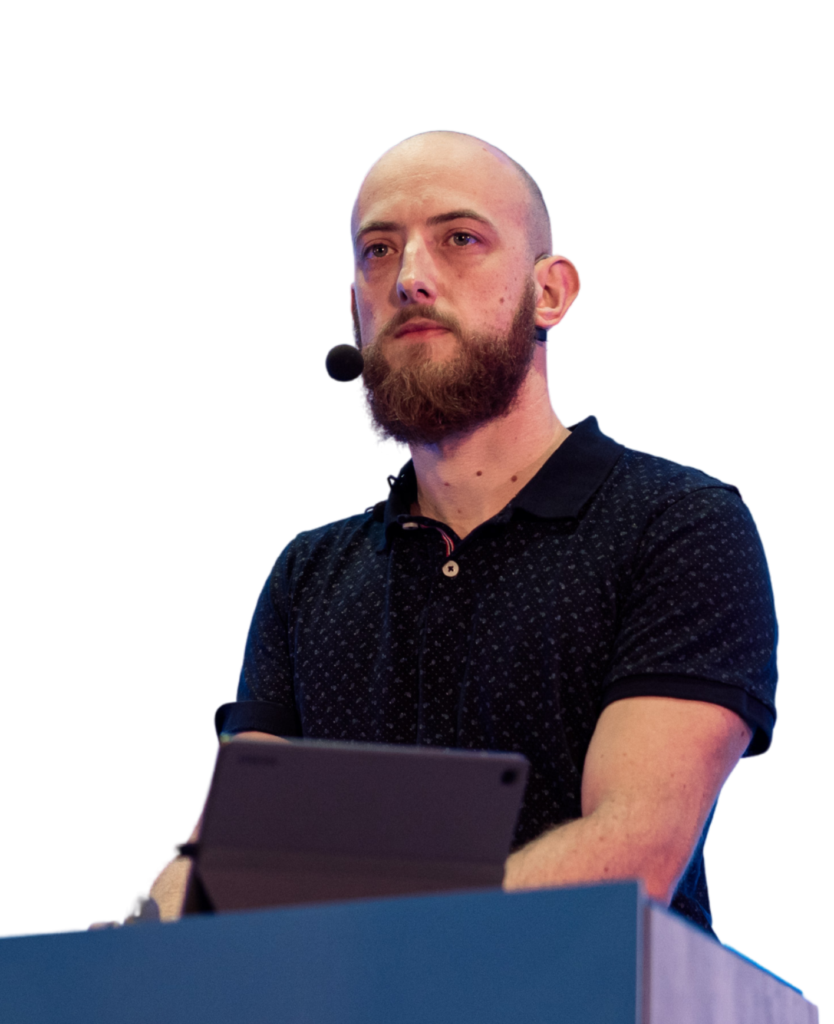
Tom is a founding member of Conscia’s Managed Detection and Response service, now protecting over 250,000 endpoints across Europe. As SecOps Automation Lead, his contributions include technical architecture, detection engineering, and automating security operations.
We Scanned 10,000 Danish Orgs Without Sending a Single Packet
Morten von SeelenWe built a passive exposure profiling engine, originally for insurance underwriters who were tired of self-reported security questionnaires. Then we pointed it at Danish critical infrastructure at… Vis mere Vis mindre
We built a passive exposure profiling engine, originally for insurance underwriters who were tired of self-reported security questionnaires.
Then we pointed it at Danish critical infrastructure at national scale. No active scanning, no exploitation. Just OSINT, pattern recognition and knowledge from thousands of incidents and access to insurance claim data. It gives us the same outside view as the attackers have.
The most interesting finding wasn’t any single vulnerability or scan. It was what the outside view turned out to predict about the inside. That pattern has now repeated across thousands of organizations, and it changes what you can actually infer from passive recon alone. What does an open port 22 whisper about your AD and backup?
I’ll show what repeats: which external signals predict real compromise risk and which ones are noise, why shared hosting with vulnerable neighbors is one of the most underestimated indicators we see, and how a handful of passive signals cluster together in ways that tell you more than you’d expect.
Some of these findings led to published investigations that forced vendors to patch or shut down parts of their operation.
I’ll share those stories. But the point of this talk isn’t the headlines. It’s the methodology and the patterns, and what you can do with them whether you’re scoping a red team engagement, benchmarking your own org, or trying to understand supply chain risk.
The session includes a live demo on stage: sector picked by the audience to full exposure profile, using simple LLMs for target identification.
Takeaways:
- What the outside predicts about the inside, and the evidence behind it
- Which passive signals matter and which ones are noise
- Shared-infrastructure risk as a leading indicator
- Live demo: audience picks the sector, we go live

Morten is Vice President at Truesec in Aarhus and builds cool companies. His work focuses on turning outside-in signals about real organizations into actionable risk insight at national scale.
Trustless Consensus Manipulation Through Bribing Contracts
Bence Soóki-TóthThe long-term success of cryptocurrencies largely depends on the incentive compatibility provided to the validators. Bribery attacks, facilitated trustlessly via smart contracts, threaten this… Vis mere Vis mindre
The long-term success of cryptocurrencies largely depends on the incentive compatibility provided to the validators. Bribery attacks, facilitated trustlessly via smart contracts, threaten this foundation. In this talk I introduce and evaluate three novel and efficient bribery contracts targeting Ethereum validators. The first bribery contract enables a briber to fork the blockchain by buying votes on their proposed blocks. The second contract incentivizes validators to voluntarily exit the consensus protocol, thus increasing the adversary’s relative staking power. The third contract builds a trustless bribery market that enables participants to auction off their manipulative power over the RANDAO, Ethereum’s distributed randomness beacon. Finally, I provide an incentive analysis of our proposed attacks. Unlike traditional exploits that target software vulnerabilities, these attacks weaponize the protocol’s own economic logic. By leveraging smart contracts it creates a trustless ‘attack-as-a-service’ platform, where an adversarial user can coordinate massive protocol deviations without ever trusting a single co-conspirator.

Bence is a Master’s student at Aarhus University and a research assistant at Eötvös Loránd University, working at the intersection of cryptography, game theory, and consensus protocols.
His current research focuses on cryptographic accumulator schemes, economic censorship games, and quantum communication infrastructure. He has previously contributed to cryptographic modules for the EuroQCI quantum communication project and investigated trustless consensus attacks on blockchains and their implications.
RTFM - Read The Fatal Manual: When Documentation Creates Critical Misconfiguration
Martin Sohn ChristensenMisconfigurations persist in enterprises despite widespread awareness - with AD CS being the prime example. This talk explores how vendors guide users into deploying critical misconfigurations, a… Vis mere Vis mindre
Misconfigurations persist in enterprises despite widespread awareness - with AD CS being the prime example. This talk explores how vendors guide users into deploying critical misconfigurations, a large-scale responsible disclosure journey, and the shared responsibilities between us all.

Martin is a Security Researcher at SpecterOps in Copenhagen, specializing in Microsoft technologies with expertise in Active Directory, identity attack paths, and secure system configuration. His perspective on security risks and challenges is shaped by a background spanning system administration, an information security degree, and information security consultancy. He is a frequent contributor to the community through online engagement and talks.
An introduction to Post-Quantum Cryptography for the practitioner
Kasper HaldA technical introduction to Post-Quantum Cryptography with a focus on what practitioners need to know. We start with the *why*: Shor's algorithm efficiently solves the factoring, discrete logarithm,… Vis mere Vis mindre
A technical introduction to Post-Quantum Cryptography with a focus on what practitioners need to know.
We start with the why: Shor’s algorithm efficiently solves the factoring, discrete logarithm, and period-finding problems — breaking RSA, Diffie-Hellman, and Elliptic Curve cryptography. For everything else, Grover’s algorithm gives a square-root speedup over classical brute force, meaning symmetric keys and hashes need to roughly double in size.
From there we look at which of today’s algorithms are at risk, what the NIST PQC standards bring to the table, and how to start preparing your systems for a crypto-agile, post-quantum world.

With an educational background in quantum theory and 20+ years within application security, this topic is where Kasper’s past and present meet.
Side Quest: "Whodunit?" – Unintentional System Compromise
Mikkel Ole RømerBuilding malware involves creative thinking in the effort of making something hostile seem legit to a computer system. A strong plan ensures the room is cleared before anyone knows Rainbow was there.… Vis mere Vis mindre
Building malware involves creative thinking in the effort of making something hostile seem legit to a computer system. A strong plan ensures the room is cleared before anyone knows Rainbow was there.
Feeding on the fine reputation of others is often a great strategy. Sometimes however, you might find yourself sharing the construction yard with the very warden itself. The side quest of “Whodunit?” traps you in a remote manor among reputable party guests unaware of your secret intentions; will you draw the hidden blade and assassinate?
In this session, we will spectate some of the hidden storylines of grand theft admin as they have unintentionally unfolded during freeze-time and before tactical operation start.

Cyber Security Expert - I am mainly engaged with adversary simulation for breach prevention. This experience includes penetration testing and adversary emulation within highly complex infrastructures of some of the largest national and international companies. Besides offensive cyber engagements I have led and designed thorough security analysis exercises of enterprise applications, including review and guidance within secure development practices.
Build your own IDS
Eleni IoakeimBy the end of this session, you will have your own IDS setup including a SIEM integration. Attending this session you will put your sysadmin skills in use and upskill your custom detection and threat… Vis mere Vis mindre
By the end of this session, you will have your own IDS setup including a SIEM integration. Attending this session you will put your sysadmin skills in use and upskill your custom detection and threat hunting capabilities. The session relies on free technologies (hyper-v, suricata, free license of ELK).

Eleni is an OT Threat Analyst at Truesec SOC in Copenhagen, with expertise in OT network security monitoring. Her work contributes to improving SOC processes and detection capabilities for ICS environments.
Her superpower is turning raw data into actionable insights — helping teams understand not just what happened, but why, and how to prevent it next time.
Netværkssession
Vi fortsætter på Fredagscaféen
Vi fortsætter snakken over en øl på Fredagscaféen.